
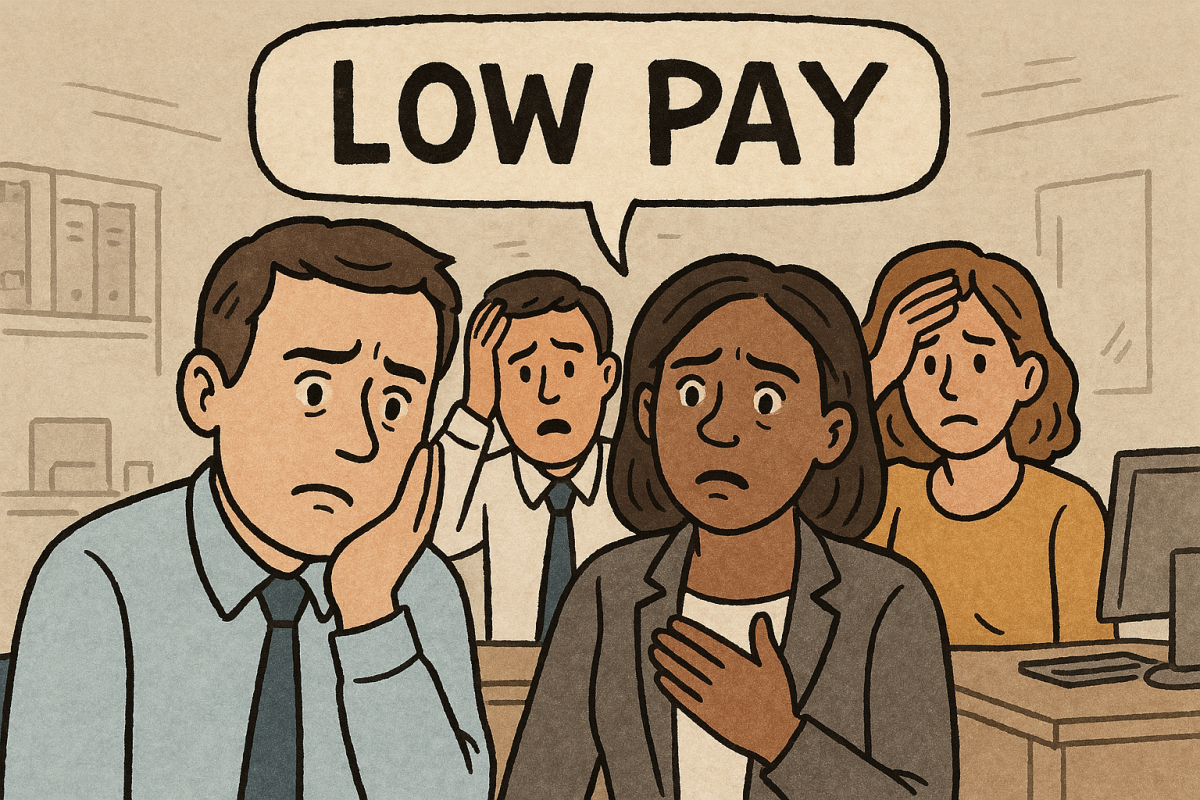
Pay is a vital issue to most workers, poll finds
ONE IN FIVE WORKERS feels severely underpaid and that they’re due a huge pay rise, according to a new global study. The international poll of 4,000 employed adults across the U.S., U.K, France, Germany, Singapore and Australia found 18% believe their pay can’t satisfy them, and they would need a 32% pay increase in order to feel like they’re getting paid enough.
Commissioned by G-P and conducted by Talker Research, results revealed that compensation remains top of mind for global workers, highlighting a direct link between employee concerns and pay transparency practices from businesses.
Only a third (34%) believe they work at organizations that practice pay transparency, either informally or through a formal policy. That policy is so important, employees say that if their current employer didn’t honor it, they’d either advocate for a formal policy change (37%) or leave the company altogether (18%).
If they were on the job hunt and prospective employers didn’t offer pay transparency, 37% would ask it to be part of their contract, 17% would ask for more pay and 11% would warn others that are also interested in the position.
Sixty-two percent are aware of how much pay their coworkers receive within their country. And of the 51% who said their company has an international presence, only 49% are aware of how much their international peers make.
Eighty-one percent said pay transparency is important to them, and half (51%) believe there are legal regulations existing today that impact how much they get paid.
Many believe their pay should be impacted by:
- Years of experience (69%)
- Individual, professional skillsets (66%)
- Location (30%)
- Local tax rates (24%).
Seven in 10 (71%) said their company should go above and beyond, by following the strictest regulations on pay transparency, even if they don’t operate in regions where it’s regulated.
Over two in five (43%) believe governments should bear the most responsibility to enforce pay equality.
Closer to home, 68% of American respondents believe the federal government should mandate pay transparency nationwide.
“A modern working infrastructure means having employees living in different states and even different countries. But global talent now expects more than just local compliance; they seek a consistent standard of fairness that respects regional context,” says Laura Maffucci, Head of HR, G-P.
“With the upcoming EU Pay Transparency Directive going into effect, pay transparency is only going to become a more important factor for workers in the future. “By adapting EU-level integrity to fit their global operations, organizations can balance local nuances with universal equity, turning regional requirements into a powerful magnet for talent.”
Thoughts on AI
The study also revealed 40% of workers think AI can make work and pay more equal between themselves and their coworkers.
In fact, a quarter (26%) would even trust AI more than human-run HR departments to audit and assess pay equity among themselves and coworkers.
Some respondents shared why they believe AI could be better suited for the task: “AI can handle and review mass amounts of information and data, far more than a human,” reported one. And according to another: “AI is often seen as more neutral and consistent because it follows data and rules without personal bias or internal company pressures.
Human resource departments may be influenced by company interests, relationships, or internal policies that could affect complete objectivity.” “The reality is, no HR team, no matter how great they are, can be an expert in every single market or stay completely detached from internal pressures,” said Laura Maffucci, Head of HR, G-P. “By using specialized AI systems—the ones purpose-built for global compliance and local laws—we’re giving our teams a neutral, data-backed foundation for sensitive issues like pay equity. “This allows AI to handle the objective heavy lifting, freeing HR to focus on the strategic work that requires human judgment and empathy.”
ADVERTISEMENT

MCGOR 10inch Under Cabinet Lighting
3. Product and service rationalization
Hiring and training new employees is significantly more expensive than retaining existing ones.
Not all products are equally profitable when costs rise.
- SKU rationalization: Use a Pareto analysis (80/20 rule) to identify the 20% of products that generate 80% of your profit. Consider discontinuing low-margin items that consume a disproportionate amount of resources.
- Value engineering: Redesign products to use less expensive components or simpler manufacturing processes without reducing the perceived value to the customer.
- "Shrinkflation" and packaging: Modifying packaging sizes or reducing non-essential features can help maintain price points that consumers are comfortable with while protecting margins.
Hiring and training new employees is significantly more expensive than retaining existing ones.
- Focus on retention: Providing non-monetary benefits—such as flexible work arrangements or professional development—can help retain staff when the business cannot match competitors' inflationary wage hikes.
- Reward your employees: Most workers say that receiving gifts would make them feel appreciated and would therefore be more likely to stay at the company, according to a recent study by Snappy.
- Cross-Training: Train employees to handle multiple tasks. This increases operational flexibility and allows the business to remain lean without losing critical capabilities during turnover.
ADVERTISEMENT

Focus on retention: Show your workers you appreciate them with employee appreciation gifts
5. Financial discipline
Cutting costs during inflation is not about "slashing" budgets indiscriminately. It is about precision pruning—removing the parts of the business that drain resources while investing in the efficiencies that allow for scalable growth even when the currency buys less.
- Debt restructuring: Inflation often leads to rising interest rates. If your business carries variable-interest debt refinancing into fixed-rate debt can prevent debt-servicing costs from spiraling.
- Tightening credit terms: Inflation erodes the value of money over time. Shortening accounts receivable cycles (for example, moving from "Net 60" to "Net 30") ensures that the business receives cash before its purchasing power diminishes further.
Cutting costs during inflation is not about "slashing" budgets indiscriminately. It is about precision pruning—removing the parts of the business that drain resources while investing in the efficiencies that allow for scalable growth even when the currency buys less.